


Hydrocyclone performance is influenced by several operating and design factors. While performance may be measured differently depending on the application, the fundamentals remain the same. Understanding how each variable effects separation allows operators to fine-tune their systems for higher efficiency, better product quality and more consistent results.
Hydrocyclones, also simply called 鈥淐yclones鈥�, separate particles according to size and/or density using centrifugal force to accelerate the settling rate of solid particles. They are cylindrical-conical shaped devices with one entrance and two exits and consist of a feed box, feed inlet, vortex finder, optional feedbox extension, cone section(s) and spigot.
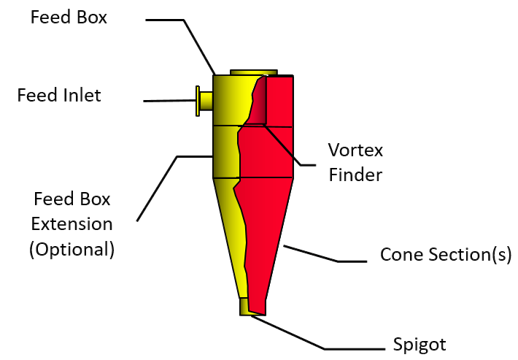
Cyclones are fed under pressure, causing the slurry to swirl around inside the cylindrical feed box. The swirling motion produces a vortex and an air core generated along the Cyclone center line. Coarse, heavy material is pulled toward the outer shell of the Cyclone, where it makes its way in a helical motion downward toward the underflow discharge at the bottom of the Cyclone. The fine, light material is pulled upward in a helical motion toward the overflow discharge at the top of the Cyclone.
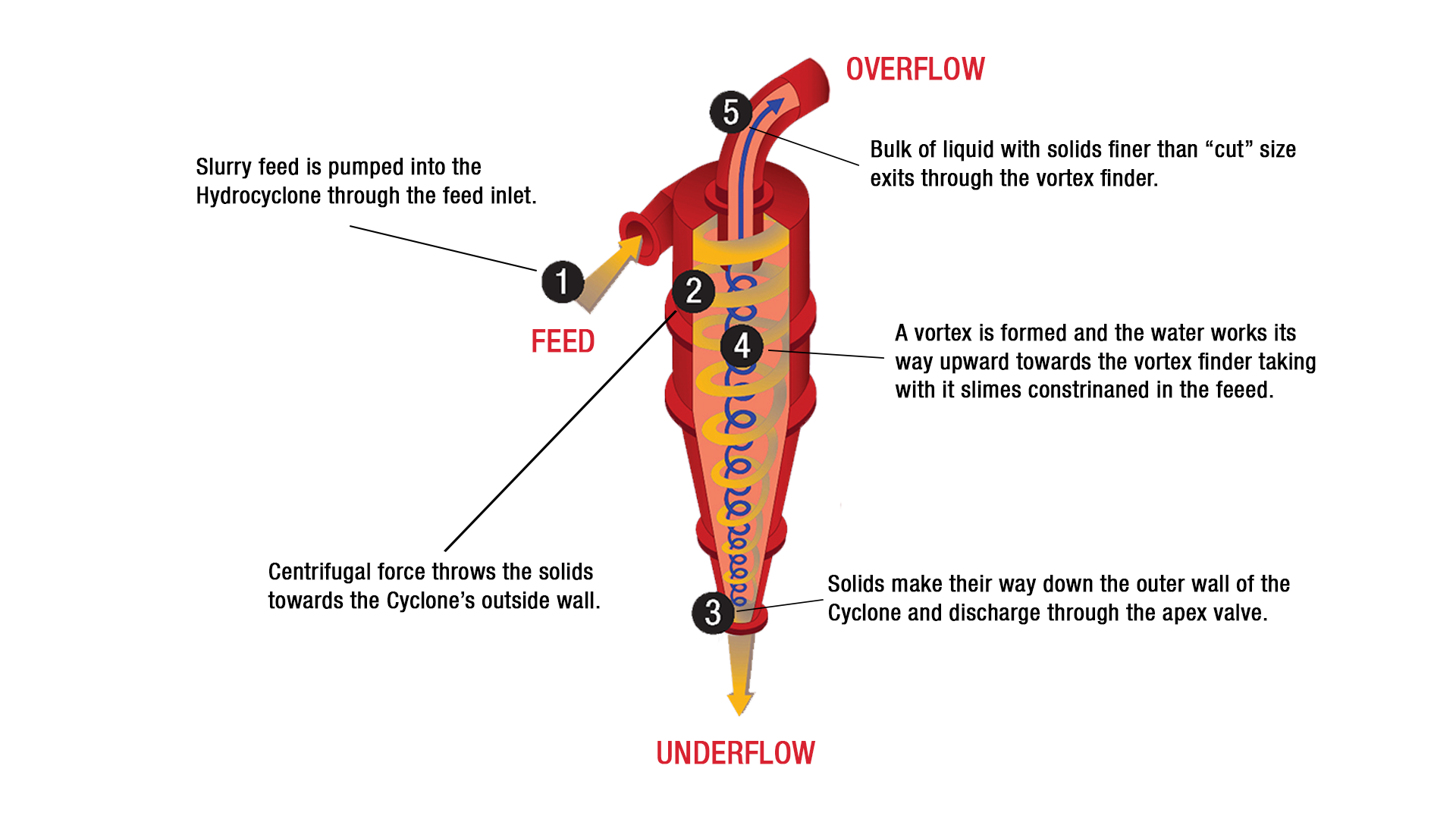
For some applications, like those making C-33 concrete sand, Hydrocyclone performance is measured by the cut point, where the underflow is more important than the overflow. For other applications, such as minerals or hard rock, the separation efficiency is more of an indicator of Cyclone performance where the overflow is more important.
In all instances, Cyclone performance can be affected by six factors, including:
- Size and cut point
- Flow rate and feed pressure
- Inlet area and Cyclone capacity
- Vortex finder diameter and separation efficiency
- Underflow diameter and operating stability
- Length of Cyclone and retention time
Understanding how each factor works and how they interact can significantly improve separation and Cyclone performance.听
听
1. Hydrocyclone Size and Cut Point
The size of a Hydrocyclone plays a key role in its performance. Inside the Cyclone, each particle migrates to a position where the centrifugal force is equal to the drag force. If the centrifugal force is higher than the drag force, the particle has a higher chance of exiting out the underflow. If the centrifugal force is less than the drag force, the particle has a higher chance of exiting out the overflow.
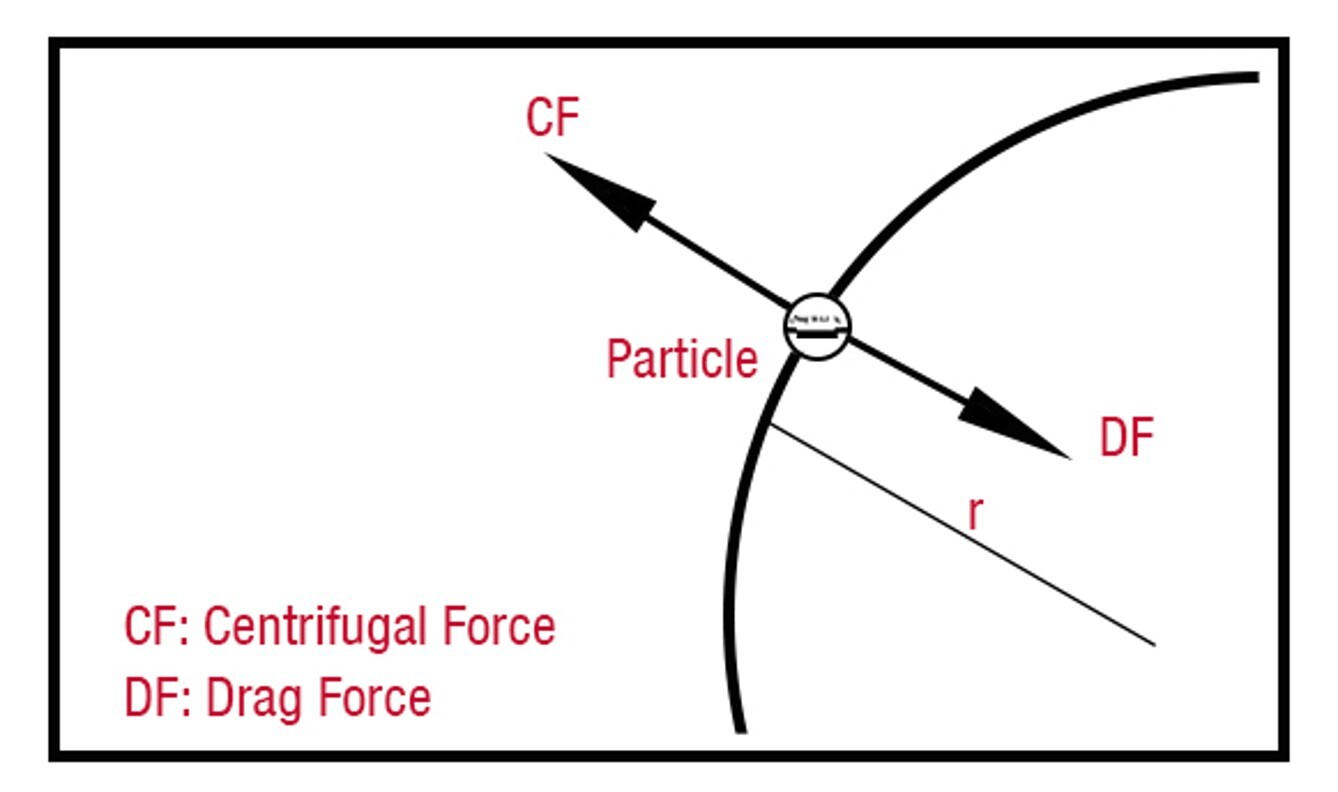
Think of it as the forces being in a tug of war, where the centrifugal and drag forces are at opposing ends of a rope and the particle is the flag in the middle. The centrifugal force tries to pull the particle toward the shell of the Cyclone, while the drag force tries to pull the particle toward the air core at the center.
Separation occurs when the two forces are equal for a particle size and the particle gets to decide which way it wants to go, toward the shell and out the underflow or toward the air core and out the overflow. There鈥檚 a 50-50 chance for it to go one way or the other, so this is called the D50 or cut point.
The size of the Cyclone affects the amount of centrifugal force that is used for separation. The smaller the Cyclone radius, the more the centrifugal force has an effect on a particle, and the stronger that force is in the tug of war. The particles are pulled more toward the shell to create a smaller cut.
The larger the Cyclone radius, the less centrifugal force is available to win the tug of war, so the cut size is larger.
For primary sand production and desliming, larger Cyclones are recommended. Fines recovery applications typically employ smaller Cyclones and potentially multiple units to obtain the desired level of fines.
Key Takeaway: Smaller Cyclones produce finer separation; larger Cyclones produce coarser cuts.
听
2. Flow Rate and Feed Pressure
Flow rate is one of the most influential operating parameters affecting Hydrocyclone performance because it directly impacts feed pressure.
A low feed pressure results in a coarser cut, while a high feed pressure results in a finer separation. Pressure can be decreased by decreasing the flow rate, or it can be increased by increasing the flow rate.
When optimizing the performance of Hydrocyclone, be it a coarser cut or finer cut, look to the Pump that鈥檚 feeding the Cyclone. The Pump provides the pressure necessary to effect separation in the Cyclone. Changing the speed of the Pump changes the pressure and flow rate.听

听
To make a coarser cut, decrease the speed of the Pump to decrease the flow rate and pressure. To make a finer cut, increase the speed of the Pump to increase the flow rate and pressure.
Key Takeaway: High feed pressure creates finer separations; low feed pressure creates coarser separations.
听
3. Inlet Area and Cyclone Capacity
The size of the inlet area determines the capacity of the Hydrocyclone. Larger inlet sizes allow for higher throughput without having to change the pressure.
To increase or decrease capacity while operating at the same pressure, look to change the size of the inlet area.
Key Takeaway: Larger inlets increase capacity; smaller inlets reduce capacity at the same operating pressure.
听
4. Vortex Finder Diameter and Separation Efficiency
The vortex finder plays a critical role in controlling both the capacity of the Cyclone and the cut point.
The vortex finder, which extends down partially in the center of the feed box, acts as a cutter. A larger diameter vortex finder allows more material to be pulled into the air core and out the overflow, creating a coarser cut. A smaller vortex finder allows less material to be pulled into the air core and out the overflow, creating a finer separation.
Changing the diameter of the vortex finder changes the pressure inside the Cyclone. A larger vortex area decreases the pressure, so more material goes into the overflow to create a coarser cut. A smaller vortex area increases the pressure, so more material goes into the underflow, creating a finer separation.
Key Takeaway: Larger vortex finder diameters create coarser separations; smaller diameters create finer separations.
听
5. Underflow Diameter and Operating Stability
The underflow diameter of the Cyclone鈥檚 apex must be properly matched to the system鈥檚 tons per hour to maintain stable operation and consistent separation. If the apex is too small, the air core cannot form properly, and the underflow will rope. This is when the Cyclone is operating at its worst.听

听
If the apex is too big, too much air will enter the Cyclone and a lot more water 鈥� and consequently, more fines 鈥� will come out the underflow, which affects the cut point.
To reduce bypass material and increase the underflow concentration in Cyclone underflow, install a smaller apex. If coarse particles are in the overflow and the underflow discharge looks like an old rope, install a larger apex.
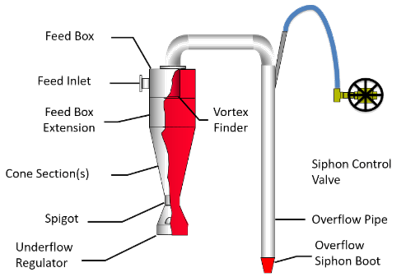
In operations with fluctuating feed conditions, maintaining the correct apex size can be challenging. This is where 厂别辫补谤补迟辞谤蝉鈩� provide an advantage. 厂别辫补谤补迟辞谤蝉鈩� are modified Hydrocyclones with an underflow regulator on the apex (or spigot), an overflow pipe and siphon valve. They were developed to ensure constant underflow density even with varying feed solids, provide online control of underflow and cut size, ensure highest underflow density possible and to eliminate plugging of the apex.
听
There are some applications that can鈥檛 keep a steady tons per hour, especially in dredge applications where the flow rate to the Cyclone and percent solids in the feed changes. With 厂别辫补谤补迟辞谤蝉鈩�, the underflow regulator stays closed via the siphon and only opens with sufficient weight of solids.

听
Key Takeaway: The apex must be sized to match tonnage and feed conditions for consistent, efficient performance. Consider using 厂别辫补谤补迟辞谤蝉鈩� when feed conditions fluctuate.听听
6. Cyclone Length and Retention Time
The length of the Cyclone influences how long material remains inside the vortex, and, as a result, how effectively particles are classified.
Longer Cyclones allow for finer separations because the material has longer time in the Cyclone to decide which way it is going to go. Shorter Cyclones make coarser cuts because the material has less time in the Cyclone before discharge.
The length of a Cyclone is determined by the conical sections, or extended feedboxes, and cone angles. A 10-degree cone angle makes it a longer Cyclone, while a 40-degree cone angle makes it a shorter Cyclone. Adding extended feedboxes increases the length of the Cyclone.
Key Takeaway: Longer Cyclones produce finer separations; shorter Cyclones produce coarser cuts.

听
Optimize Hydrocyclone Performance
To accurately assess the performance of a Hydrocyclone, operators should routinely sample and measure the feed, overflow and underflow. By understanding how size, flow rate, inlet area, vortex finder diameter, apex size and cyclone length play a role based on the goals of the application, adjustments can be made to optimize efficiency and product quality.听
听


