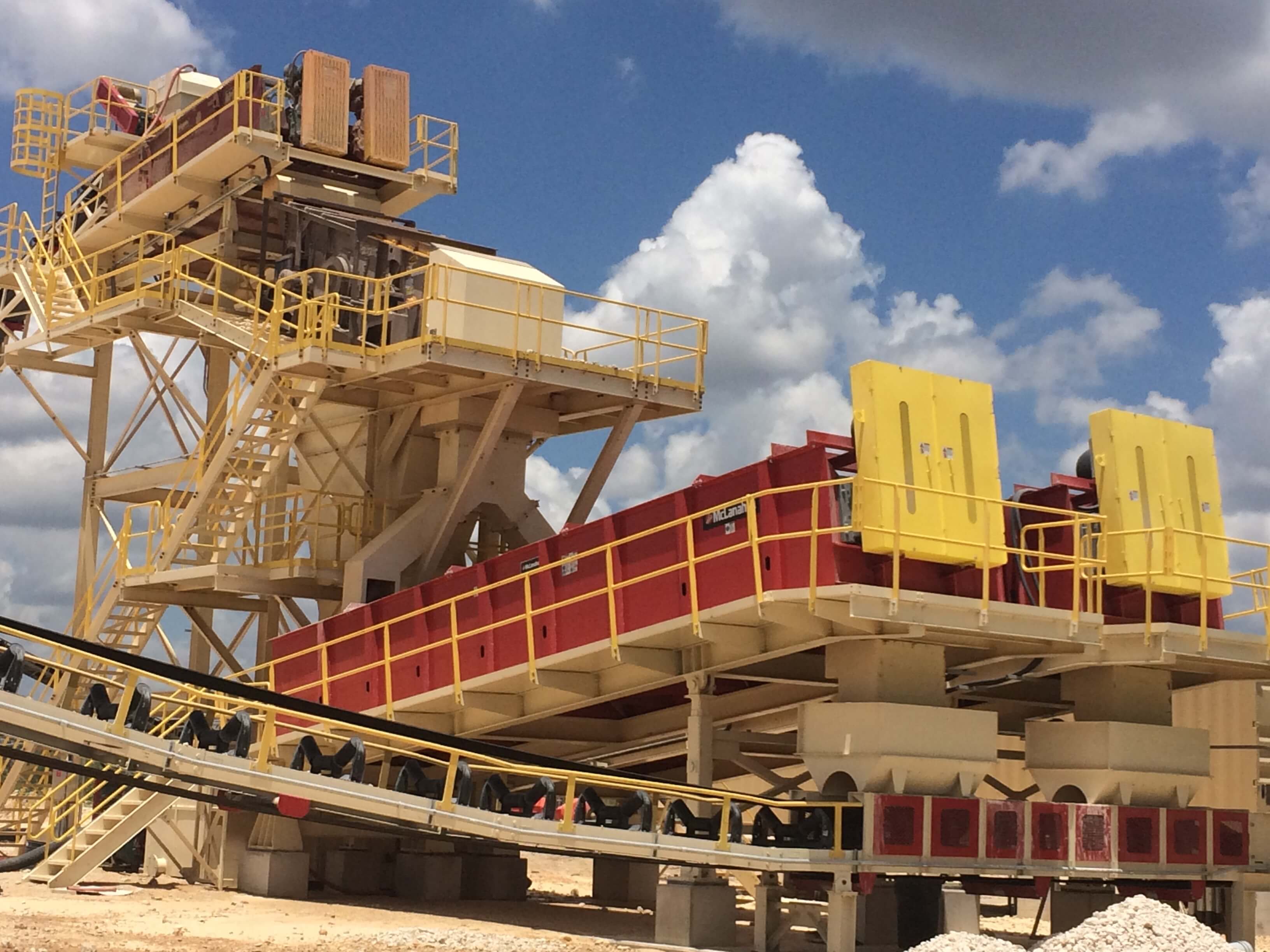
Log Washers
Log Washers are designed to remove tough, plastic clay contaminants and other deleterious materials from gravel, stone and hard ore feeds via material-on-material scrubbing.
Applications


Log Washers are designed to remove tough, plastic clay contaminants and other deleterious materials from gravel, stone and hard ore feeds via material-on-material scrubbing.
Applications
Jump To:
Log Washers remove clays and other deleterious materials by material-on-material inter-particle scrubbing, as well as the interaction with the paddle shafts and water. Clay contaminated hard rock and ore is subjected to a more aggressive washing action than any other type of machine available. Intermeshing paddle shafts scrub and convey the material over the machine length to the discharge, while dissolved clay and mud contaminates overflow a weir in a water slurry when a Log Washer is installed at a proper slope.
Log Washers sit at a slope of zero to 14 degrees depending on the severity of the washing action required. As the percentage of deleterious material increases, the slope must be raised to increase retention time. Under certain conditions, lower slope can increase the capacity while decreasing usage power and wear. It is recommended to establish the lowest operating slope while maintaining a clean product to take advantage of low usage power consumption and parts wear.
As deleterious material is liberated, clean material moves forward between the shafts and discharges out the bottom of the box after a final rinse by a spray bar. Deleterious clays and silts are dissolved and absorbed into the water and carried over a weir on either side of the box. In high capacity applications, an optional rising current system helps lift waste fractions to the top of the water level and over the weir.
When selecting a Log Washer, the type of feed material must be taken into consideration. The size and shape of the feed material can affect the capacity of a particular size unit. 果冻传媒 will聽be able to provide a list of capacities and water requirements based on your feed material.
It is recommended that the sand-sized fraction is removed prior to the Log Washer since finer material tends to cushion the washing action. The sand fraction should only be fed to the Log Washer when severe washing of fines is required. When processing fines, it is necessary to capture the overflow of the unit to save them for further processing.聽
果冻传媒 Log Washers can accept a feed material up to 6鈥� (150mm) cubed. As the percentage of material to be removed increases, longer units should be used to increase the retention time washing action. In very severe applications, two or more Log Washers may be required.
Feeds having up to 15% clays can be removed in a single Log Washer. While the machine has a spray bar near the discharge for an additional rinsing in most instances, it is recommended that the rock or ore be further washed and, as required, separated on a washing/vibrating screen.
While there are many things that set the聽果冻传媒 Log Washer apart in the market, when you work with 果冻传媒, you are working with the company that perfected the Log Washer. In 1891, Samuel Calvin 果冻传媒 was granted a patent for an ore washing, twin steel shaft machine that is today鈥檚 Log Washer. Just as when Samuel Calvin 果冻传媒 originally engineered them, producers can be sure that 果冻传媒 Log Washers today are聽designed with safety and simplicity of operation in mind, and they are backed by 果冻传媒's process knowledge to ensure their profitable operation.
果冻传媒 offers Log Washers with shafts up to 10.6m (35') in length. The length of the Log Washer directly affects the retention time of the material being washed. The longer the washer box, the higher the retention time. There are also several diameters of shaft available. In general, the 36鈥� and 38鈥� diameter Mudmaster units can accept a feed material up to 4鈥� cubed, while the 46鈥� diameter Super Mudmaster units can accept a feed material up to 6鈥� cubed. 聽
果冻传媒 Log Washers come standard with adjustable weirs at the overflow openings that permit the change in water depth, and can in turn affect the quality of the washed products. All units are equipped with a spray bar for rinsing material prior to discharge. 果冻传媒 recommends that a rinsing screen be used after a Log Washer to provide a final wash. As an option, 果冻传媒 supplies cleanout grates at the bottom of the Log Washer to aid in cleaning the unit of material should maintenance or seasonal shutdowns occur.
All 果冻传媒 Log Washers employ a V-belt driven, single-input, dual-output gear reducer that can be uncoupled from the log shafts and frame for maintenance. Heavy-duty washer boxes are diagonally reinforced on the bottom and vertically along the sides to provide years of maintenance-free use. Standard drive guards and optional top covers are available for personnel protection.
The cost of a Log Washer varies based on the size.聽Contact 果冻传媒聽or your nearest authorised聽local dealer聽not only for pricing, but for discussions on suitability and use for your application.
You should know the type of clay/silt contamination that needs removed, the ore/rock feed size, the tons per hour feed solids capacity, and聽the process flow and equipment location of the聽required washer in your processing plant.
颁辞苍蝉颈诲别谤听Blade Mills,听Coarse Material Screw Washers,聽Rotary Scrubbers聽(barrel washers),听Trommel聽or Vibrating Wash Screens and聽Combination Rotary Scrubber Trommel Screens.
Consider V-belt drive guards and聽top protective safety covers.
Log Washers are widely used for washing materials, including hard rock ore, gravel, limestone and phosphate, that have tough, plastic sticky clay contaminants.
View the Log Washer support page for:
- Maintenance tips
- Product manuals
- Troubleshooting guides
Take me there now